Description
Overview
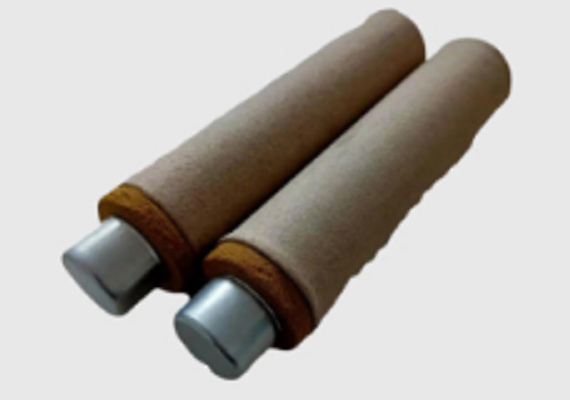
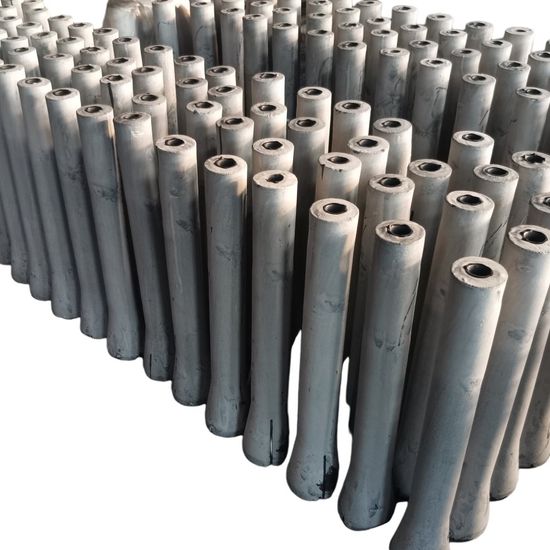
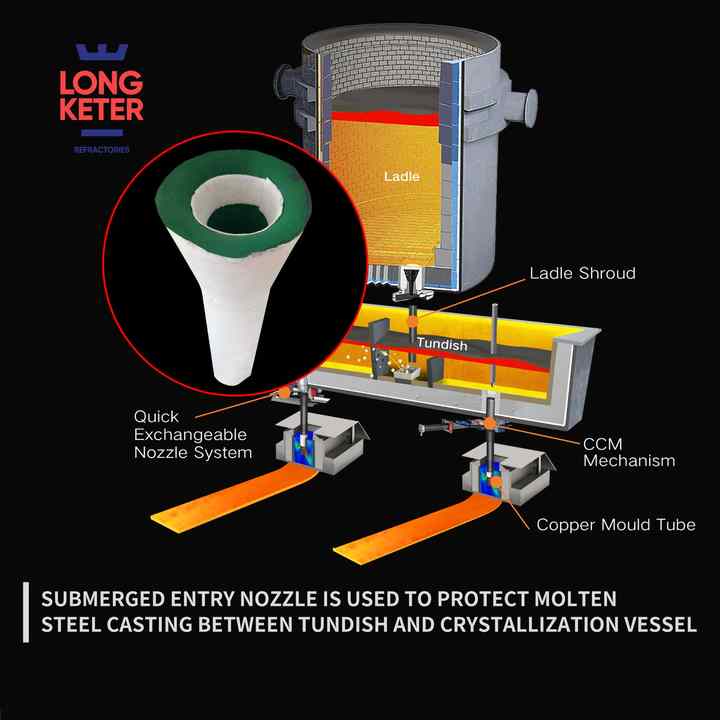
The submerged entry nozzle — SEN — is the last refractory in the steel flow path of continuous casting. It connects the tundish to the mould, carrying the molten steel from the tundish down into the mould while keeping the stream shielded from air. Because the nozzle is submerged below the mould meniscus, the steel enters the mould without reoxidation, and the side ports at the tip direct the flow so the mould level stays calm and the mould powder melts evenly.
We distribute submerged entry nozzles in alumina-carbon (Al2O3-C), alumina-zirconia-carbon (Al2O3-ZrO2-C) and fused silica materials, for billet, bloom, slab and thin slab casters. The body is alumina-carbon for thermal shock resistance; the slag line is zirconia-carbon for erosion resistance, and the bore can be supplied with an argon injection system to prevent alumina clogging. Nozzles are made to drawing to match the tundish, the mould section and the casting speed.
Applications
- Continuous casting, tundish to mould steel transfer (billet, bloom, slab, thin slab)
- Slab casters, bloom casters and billet casters
- Aluminium-killed and calcium-treated steels (argon-injected bore available to prevent clogging)
- Quick-change SEN systems and standard SEN systems
Specifications
- Materials: alumina-carbon (Al2O3-C); alumina-zirconia-carbon (Al2O3-ZrO2-C); fused silica
- Body: Al2O3 ≥50%; C+SiC ≥20%
- Slag line: ZrO2 ≥65–76%; C+SiC ≥11–15%
- Bulk density: ≥2.40–2.55 g/cm³ (body); up to ≥3.70 g/cm³ (slag line)
- Apparent porosity: ≤17–18%
- Cold crushing strength: ≥22 MPa (body); modulus of rupture ≥6 MPa
- Total length: approx. 540 mm (billet); 820–920 mm (slab)
- Bore: upper inner diameter 75–80 mm; lower inner diameter 70–76 mm
- Immersion depth: 135–175 mm (slab); side-port top to meniscus 50–150 mm
- Argon flow (anti-clogging): 15–35 L/min
- Port angles: upper port 20–30°; lower port 10–20°
- Dimensions: made to drawing, to match the tundish, mould section and casting speed