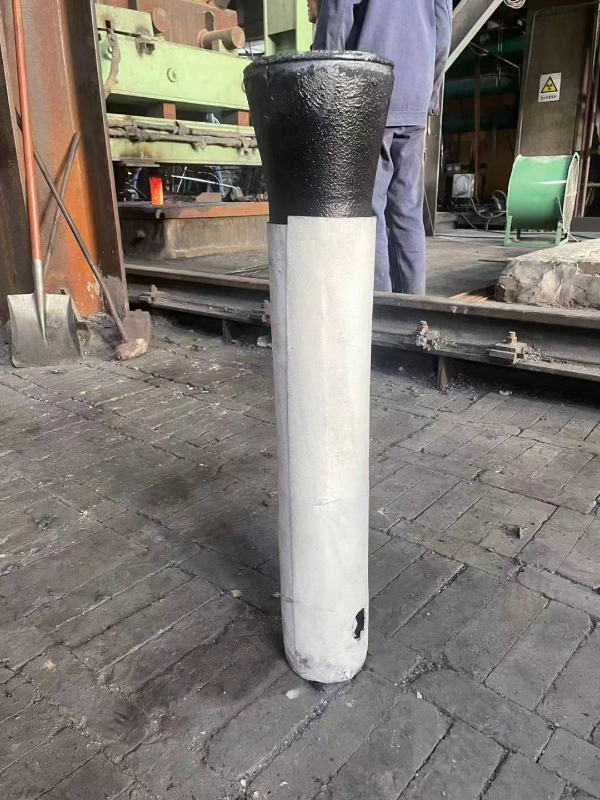
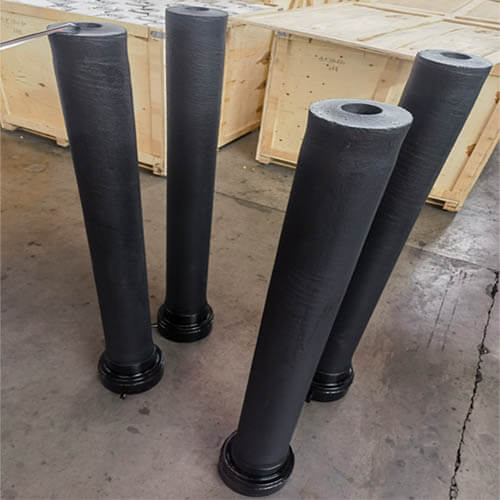
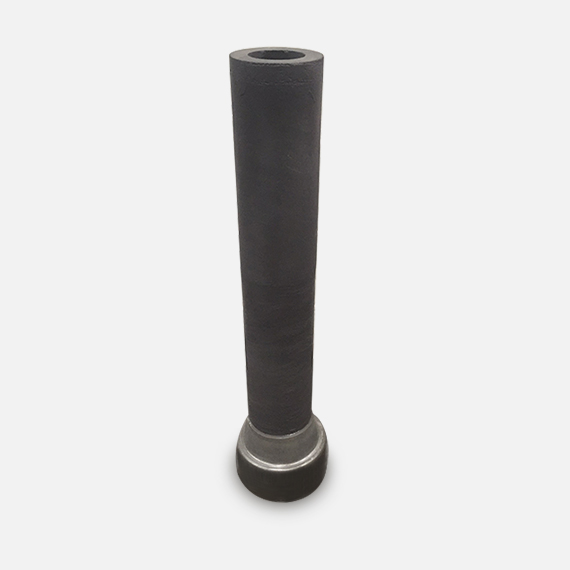
Description
Overview
The ladle shroud — also called the ladle long nozzle — is the refractory tube that connects the ladle to the tundish in continuous casting. It carries the molten steel from the ladle down into the tundish with the stream fully enclosed, so the steel never touches air on its way down. Without a shroud the open stream would pick up oxygen and nitrogen and carry slag into the tundish; with a shroud the steel arrives clean, and the tundish can hold a stable level for the whole sequence.
We distribute ladle shrouds in alumina-carbon (Al2O3-C) with a zirconia-carbon (ZrO2-C) or magnesia-spinel slag line, in preheating and preheating-free types. The outer and inner surfaces carry an anti-oxidation glaze so the carbon in the material does not burn off during preheating and casting, and the joint with the ladle nozzle is argon-sealed. Shrouds are made to drawing to match the ladle size, the tundish and the casting sequence.
Applications
- Continuous casting, ladle to tundish steel transfer (billet, bloom, slab)
- Preheating-free direct use and preheated use
- Clean steel and high-purity steel grades (low-silica, low-carbon bore options available)
- Long casting sequences; shroud change during ladle change
Specifications
- Materials: alumina-carbon (Al2O3-C) body; zirconia-carbon (ZrO2-C) or magnesia-spinel slag line
- Body: Al2O3 ≥45–50%; C+SiC ≥22–26%
- Slag line: ZrO2 ≥50%; bulk density ≥3.10–3.40 g/cm³
- Bulk density: ≥2.35–2.40 g/cm³ (body)
- Apparent porosity: ≤18%
- Cold crushing strength: ≥20–22 MPa; modulus of rupture ≥5–6 MPa
- Total length: 1.5–1.8 m
- Bore: inlet inner diameter 90–110 mm; outlet inner diameter 150–200 mm
- Immersion depth: 100–200 mm into the tundish steel
- Bowl: top width 100–150 mm; bottom width 50–76 mm; height 30–45 mm
- Surface: anti-oxidation glaze coating on outer and inner surfaces; argon sealing at the ladle nozzle joint
- Dimensions: made to drawing, to match the ladle, tundish and casting sequence